Jet engine technologies for interested amateurs
Last Updated: 1 April, 2002
[an error occurred while processing this directive]
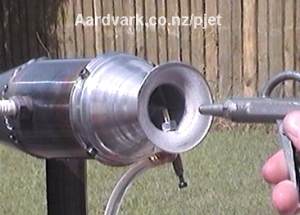
Pulsejet engines have a sometimes deserved reputation for being very difficult and problematic to start -- but fortunately this doesn't always have to be the case. In order to start a pulsejet you need three things:
The Fuel For the purposes of small pulsejet engines however, the most common fuel is gasoline of some kind. This can be white-gasoline or low-octane gas from the local pumps. You can use high-octane gasoline but you'll simply be wasting money and possibly getting a little less power at the same time. In cold conditions where the air temperature is less than 60 degrees F or around 17 degrees C you may find that gasoline isn't sufficiently volatile to ignite reliably when starting an engine. If this is the case then it is recommended that you add some ether -- up to 25 percent. This will significantly increase the ease with which the fuel can be ignited. Cold can also affect engines that are using propane/LPG because the pressure available from a tank of this gas reduces quite significantly as the temperature drops. It's worth mentioning at this stage that there are two methods of delivering the fuel to the engine:
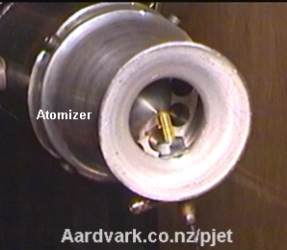
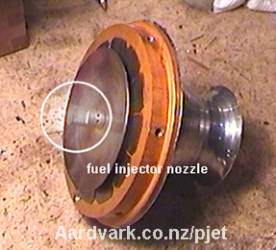
Just supplying the engine with fuel is not enough -- you need to force some air into the intake so as to create an explosive mixture inside the engine. In the case of an injected engine, an air source such as a leaf-blower or vacuum-cleaner with a blow attachment will likely do the job. You don't need a lot of pressure but you do need a reasonable volume of air. With an aspirated engine you'll need less volume but more pressure. This is because the air has to draw the fuel up the fuel-line and atomize it into a fine spray before it passes through the valves into the engine. An air-gun driven by a compressor is perfect for the job but if you don't have such luxuries available to you a great substitute is to inflate a car tube or tire without a valve in it -- using a length of flexible plastic tubing slipped over the valve stem to deliver the air to the engine's intake. The flow of air can be controlled by kinking the tubing. Slipping a thinner piece of pipe into the open end of the tubing will give you a narrower and more easily controlled air-jet to spray into the engine. Between starting attempts you can replace the valve and pump the tire up to 40-60 psi using a foot-pump or whatever. This is a great low-cost way to start your engine at the flying field or away from other sources of compressed air.
The Ignition Source The simplest but least effective ignition source is a naked flame situated at the end of the tailpipe. This could be a gas-torch or a spirit burner but you'll find starting an engine using this method to be more difficult than with a sparkplug. One other technique sometimes used when a sparkplug isn't mounted in the engine itself is a spark-wand. This consists of two wires, separated by an insulator with a spark-gap at the end. It is inserted and energized when starting the engine and quickly withdrawn once it is running.
Putting It All Together
At this stage the engine should at least pop, bang or burb a little, even if it doesn't immediately burst into life. If you don't get much activity, try richening the mixture a little by losening the locknut and opening the mixture screw by a quarter of a turn. Repeat this process until things improve. If they don't improve, return the screw to its original position and try closing it a quarter turn at a time in case the mixture is already too rich. When you've had a little practice and got the mixture setting sorted out then it should be as easy as in the video below of an aspirated PJ8 being started:
The procedure is even simpler for an engine with direct LPG/propane injection. Thanks to the fact that the fuel is already in the engine's combustion chamber, all we need do is turn on the spark and blow some air into the intake. If the engine doesn't fire immedately then the gas should be turned up or down until the engine starts. If you still have trouble, try varying the amount of air being blown into the intake. Once you get the hang of starting a LPG-injected pulsejet its exceptionally easy to do.
|